
When my brother and I start our 2nd year of Catholic CCD class in 1978, we receive an introduction into a world we could have never imagined prior, and it changes our lives forever.
The First Communion
The Gospel According To Atari
The first time I play a home video game it is, quite literally, a religious experience.
When we are very little, my mom has a group of kids over to our house but I have no idea why.
Jeff and I are told to stay in our room, but we both sneak out to see what is going on.
They are all sitting in a circle in the living room, reading from some weird little brightly colored books. My brother and I peer at them from the shadows, just behind the edge of the couch in the hallway with the light fixture that only works some of the time.
Later when we ask, my mom explains that she was” teaching CCD class”, which has something to do with the large Catholic church we attend with her most Sundays.
Like many of the things my mom tries out, it doesn’t last very long.
Maybe 6 months or year and then there is nary a mention of it again in our house.
Like it never existed.
—
We attend Catholic Mass on most Sundays, but my dad is not into it.
In fact, he actively avoids it.
I figure it was just something we do to get us out of the house to waste time between the Ch. 5 Tom Hatten Popeye show in the morning, and Ch. 9 Horror film Festival in the afternoon.
That is until the 2nd grade, when my mom tells us that we are indeed Catholic, and it is our duty to attend CCD class ourselves.
The class is a weekly one-hour session with other kids our age that is designed to prepare us for the second most important Catholic Sacrament: First Communion.
This in and of itself is not terrible news.
Falling in love with Star Wars earlier that year has opened the door for me to accept the nature of a dualistic morality in the universe.
Even though I’ve been to church many times before I saw Star Wars, the mythology laid-out in the simple story of good and evil turns me into a sponge for morality tales.
It feels genuine to me,
but also scary,
because, for the first time,
I am thinking about death
What strikes me the most is: the uncertainty.
Not much is neat and tidy in the Catholic teachings.
Jesus looks like a hippie, he loves everyone, he turns the other cheek.
That seems pretty cool to me.
In the gospels, people make mistakes, people are punished, things don’t always work as planned, but there is always a path.
This seems far different from the utopian, homogenized people yelling about God on Sunday morning TV.
A little bit of chaos and a bit of hope to get through it all.
I can deal with that.
It makes sense.
It feels a bit like Star Wars.
Obi-Wan Kenobi died for Luke.
Jesus DIED for us.
Those X-Wing Pilots died for their cause.
I would DIE someday too.
What would I die FOR?
Anything?
—
Jeff and I happily attend our own CCD class throughout 2nd grade.
It is held a few blocks away from us in a nice lady’s house.
Every week we get together with a bunch of other kids, read passages from four brightly colored books named gospels, while eating Oreo cookies and drinking Hawaiian punch that are supplied by each kid’s family through a round-robin snack schedule.
It is economical and dare I say “fun”.
I learn a little bit about the stuff the priest says at mass on Sunday.
All feels right with the world.
However one thing I notice during the year is that there were no other kids from our own grade in the CCD class.
In fact some of the kids I recognize are from first grade.
There is an obvious reason for this that I only discovered later: my mom and dad did not agree about us attending CCD.
My dad is staunchly opposed.
When he finally gives-in, it was an entire year too late.
This means that, as Second Graders, we will be stuck with a bunch of younger kids for a long long time in CCD class.
First Communion CCD is a two year program, starting when you are in First Grade and culminating with a sacramental ceremony at the church at the end of 2nd grade.
But for us it will be 2nd through 3rd grade.
Each year is a different person’s house.
The teacher the second year teacher lives further away and the time conflicts with my sister Mari’s guitar lesson at Gene Lee’s guitar shop every other week.
So for the 2nd year my mom has arranged for us to carpool with a younger kid who lives up the street.
Neither of us are happy about this.
At eight years old, a one year difference is not just huge.
It’s giant.
And there is more.
She’s a girl!
Could it be any worse?
No.
It got better.
Much better.
—
The “Second Grader” is nice girl from up the street named Lori
(Note: Lori’ was a real person but I’ve changed her name)
Lori lives up the street in a house just a bit smaller than ours.
She lives with her mom and grandmother.
Her dad was nowhere to be found.
No utterance of his existence is ever made.
The first day of the first CCD meeting of our 2nd year,
My brother Jeff and I walk up the street to Lori’s house.
We arrive about a half-an-hour early, and Lori’s mom leads us to Lori’s room where she is busy pressing the letters on a yellow and red box with a digital display, and rows and rows of buttons with letters on them.
“H” “O” “U” “S” “E” whines an electronic voice from the box, “HOUSE”
The thing talked!!
The name on the box says “Speak & Spell”
I look around Lori’s room.
I’d never seen anything like it.
She has a robot in one corner with the name 2XL written on the front.
Electronic games are scattered all-around,
She has her own radio and TV set.
It is like the basement of Sears come-to-life in front of my eyes.
the most amazing thing in her room though,
and the thing that eventually make me never want to leave her house,
is the was the
wood-paneled,
heavy sixer,
first edition
Atari VCS
video game console
hooked-up
to her TV,
10 game cartridges in colorful boxes are scattered on the floor around it.
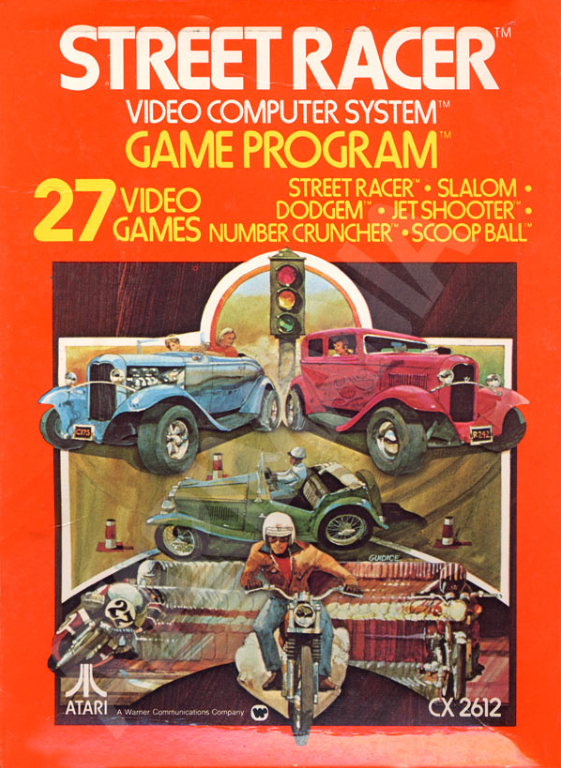
The boxes have amazing paintings on the covers, and enticing names like “Combat”, “Air Sea Battle”, “Indy 500”, “Surround”, “Video Olympics”, “Star Ship”. “Street Racer”, and “Outlaw”.
Somewhere in the back of my mind I’ve cataloged the name Atari as synonymous with video games.
The Pong machine in Sears basement.
The arcade games in the Old Town Mall arcade
Advertisements in SoccerNow or Boy’s Life?
The Sears Video Arcade version of the Atari VCS in the Sears Wish Book.
I know instantly what it is, and I am instantly drawn to it.
What I do not know yet, however,
is just how inclined
I am
to fall in-love with it.
—
The Atari VCS began its life as code-named project Stella in the bowels of Atari’s engineering department sometime in 1975 or 1976.
It uses a powerful but cheap new microprocessor named the 6502, and includes a dedicated TIA microchip for handling graphics, sound and controls.
The machine is super efficient with just enough power to replicate most of Atari’s existing coin-operated video games.
The idea was to continually replicate and release versions of the coin-op games as interchangeable cartridges.
The system had 128 bytes of memory – not even enough to hold a single Tweet), and could display five total objects on the screen: 2 players, two missiles and a ball.
Its true power lies in the way programmers put images on screen.
Code is written to draw every scanline of the television display , and while the scanlines are being drawn, the programmer has almost complete control over the display: objects can be copied, colors changed, etc., as long as all the work was done within the 74 CPU cycles before the electron gun in the TV jumped down to the next scanline.
It is primitive compared to anything that comes after, but is also very very flexible and that flexibility makes it a success, even though programming games for it was extremely difficult.
—
“Street Racer” is in the console already, and Lori shows Jeff and I how to start a 2-player game by pushing the [Select] button to cycle through the game variations in the cartridge.
She stops on one of her favorite games, and hands each of us a small, boxy controller with a wheel on-up connected by a wire to the console.
Later I understand that these are called paddles.
I look on the back of the “Street Racer” box and noticed names of the games printed on the outside.
Lori had stopped on variation #22.
Apparently this is a game named “Number Cruncher”.
What happens next is the wildest head-to-head game Jeff and I have ever played in our lives.
At the bottom of the screen there is a little set of blocks that represent a car.
I know it had to be a car because the front of the Street Racer box has some really cool paintings of classic cars gunning for a race.
The screen is split down the middle,
and we are both playing at the same time.
When the game starts, numbers fall from the top of the screen.
By hitting them with my car directly in the front,
the value of the number is added to my score.
However, if I hit them from the side,
my car will “smash” with a stomach churning sound, and everything stops.
If I press the red button on the side of my controller,
the numbers speed-up.
This means I can score more points faster,
but also makes it much easier to smash-up.
My twin brother and I have been playing games together for many years,
but most of them have an air of “unfairness” about them.
We never really knew who “won” at guns, because you couldn’t really tell who was hit.
We never knew who won a close bike-race because there are inevitable disputes about the finish line.
We even had disputes about tennis-racket baseball, because it is not always clear where balls land when they hit the garage.
Yet here, sitting side-by-side, playing Street Racer, there can be no disputes.
The machine keeps the score, keeps the rules, and keeps it all fair.
It is, in a word, a Revelation.
We have a little time for one more game after Street Racer.
Lori unplugs the paddles and plugs-in two joysticks into ports in the front of the console.
She turns off the power, unplugs Street Racer, and puts in a game named Combat!
She Selects a game, and pushes reset.
At that moment, she and I are thrown into a virtual battleground, each controlling a tank, shooting at each other.
I realize then that I’ve seen this game before, running on TV in the basement of Sears.
The battlefield is abstract, but the tanks look more accurate than the cars in Street Racer.
However, no matter how it actually looks on-screen, the art on the box for Combat! set the tone.
It shows a set of tanks in a furious battle, and to me, the two images, screen and box, are cemented together forever.
The game I am playing was that box-art, no matter what shows the TV.
The 30 minutes before CCD class were up too soon.
We car-pool with Lori every week from then on.
We always arrive ½ hour early each time.
And all three of us play Atari.
—
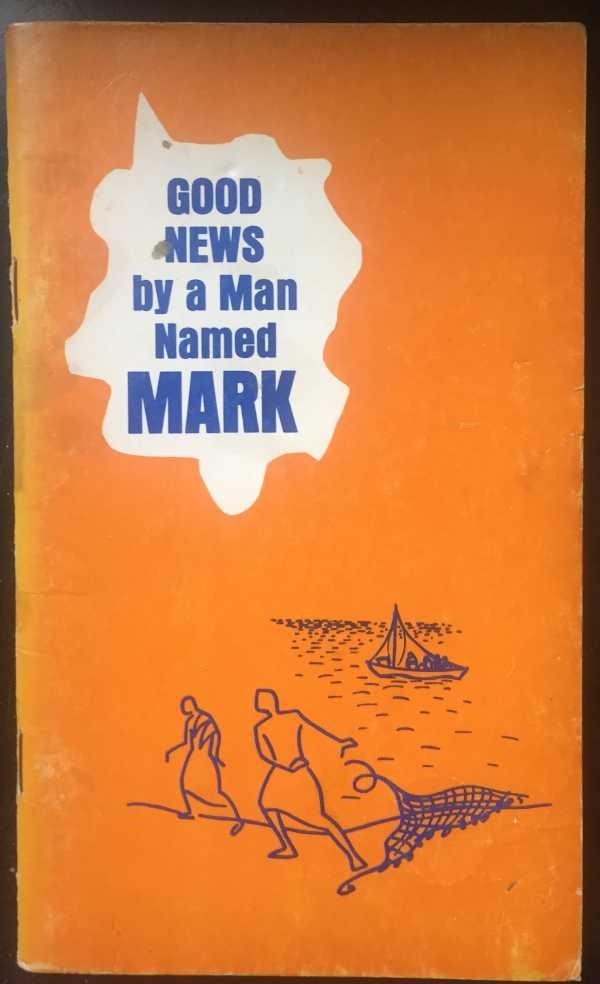
Required reading for CCD class is four “gospels”: mini, brightly colored books that represent the biblical gospels of Matthew, Mark, Luke and John.
We receive them on the first day of our first year.
They are the same books my mom used when she taught CCD.
I’m no expert, but I think my mom told me that the Catholic Church was not too keen on their parishioners reading the entire bible, so instead, they pre-packaged and markeed the parts they thought would have the biggest impact.
These brightly colored, keenly packaged books are designed to teach us 70’s kids that Jesus was a cool dude who helped the sick, fed the hungry and fought for what was right.
At least that’s what I’m getting out of it anyway.
They look just like this:
While these books represent what I was supposed to be learning,
Their message is entwined.
Every week we play Atari at Lori’s house and pull games out of brightly colored boxes.
Then we carpool with her to CCD where we read passages from brightly colored gospels.
I accept the latter because I’m finding myself drawn to the former.
In third grade we are learning a “gospel” all right.
A message is certainly getting across.
But it might not be the same message my mom intended.
—
“Where is your brother?” my dad asks, as I play with my Matchbox construction vehicles and I work my favorite dirt patch in the backyard.
“I haven’t seen him,” I reply, pushing some dirt with the bulldozer to start laying the path for a road.
Just then, like it was meant to be. Lori and Jeff came zooming down our driveway on roller skates.
I’ve never seen Jeff on roller skates before.
My dad eyes the 7 year old girl with his 8 year old son.
“Ah, that’s where loverboy has been,” he whispers loud enough for me to hear.
He laughs to himself.
“Loverboy?”
I am bothered by this description.
Jeff is just playing with Lori.
What is he talking about?
It makes me uncomfortable to think my dad will laugh at me if I like girls.
Dad.Girls.Laugh.
Brain wired.
A wall of self doubt about girls builds around me.
The effect will last well into high school.
—
We may have been lured at first by the Atari and all of Lori’s other cool toys but it is nice to have a regular friend who lives close that we can play with on a regular basis.
By early 1979 Jeff and I are hanging out at Lori’s house before and after CCD class, on the weekends too.
The three of us become pretty much inseparable.
Some of this is a way to escape our own house.
Gramps has lung cancer now from smoking a pipe all of his life.
My dad has been rifling through all of his Prevention magazines to try to find natural cures.
He is planning a trip to Mexico to get his dad cancer medicine that has not been approved by the FDA in the United States.
He said something about Laetrile, apparently a Cancer cure created from apricot pits or something.
Dad is gone a lot, visiting his own dad and trying to figure out how to save him.
My mom is in a deep depression about the death of aunt Pat and cousin Greg who died in sudden car crash in late 1978.
Lori’s house is a welcome respite from the darkness we all were feeling down the street.
As the months wear on, our friendship with Lori branches-out.
There was always an “Atari” session in those visits, and Lori’s mom expands her game library to includes Human Cannonball, Bowling, and more.
Lori hardly ever comes over to our house though.
There is nothing there for her to do here except play in the driveway
So we spent an inordinate amount of time up the street at her house
The “outside” is the main domain at our house.
The walled back-back yard, the backyard filled with decaying vehicles.
The long suburban driveway where almost everything significant occurs.
Our house was the domain of the old.
Lori’s house is all about the inside.
The new world.
Electronic toys, gadgets, video games, pay-TV.
Lori’s house is set-up to accept and play in this new world.
We watch Select TV movies with her and her mom on Friday nights.
One night we all sit-down and Corvette Summer with Luke Skywalker (Mark Hammil)
Lori’s mom whoops a loud “whoo hoo” when Annie Potts’ character tells Mark Hamill “let’s screw” as they sit in her converted van.
CCD this is not.
Still, if there are any three kids who could be called best friends, it was Jeff, Lori and I.
It is the first time I have ever experienced this in all my life.
—
We attend Lori’s 8th birthday party in 1979.
Her mom buys her a slew of new Atari cartridges.
Jeff and I arrived at the party early, and the three of us jump into playing the VCS.
However, as more people arrive at the party, Jeff and Lori go to the back yard to join everyone else on the new swing set.,
I find myself unable to move.
I am caught in the clutches of a game named “Breakout”, and I can not escape.
—
I now know that I was not alone in this feeling for Breakout.
Many years later I discovered a book by David Sudnow named Pilgrim In The Micro-World .
Sudnow spends many chapters discussing his fascination with Breakout.
The difference is that he discovered it when he was a grown man, and I discovered it just after I turned 9 years old.
I think now that the game is a masterpiece: the first real “casual” and certainly one of the most insanely addictive experiences ever conceived. It also erased the gap between man and machine.
Sudnow wrote eloquently about the new human machine interface that was created when someone picked-up a paddle controller and started to play Breakout.
“How strange and utterly marvelous it was that in the very first moments with Breakout one naturally transcended the artificial element without even noticing it.”
—
Similar to seeing Star Wars in a movie theater in 1977 when I was seven,
I feel revolutionized again playing Breakout.
I am 9 years old in 1979, playing a home video game on the floor of my Catholic CCD friend’s bedroom and do not ever want to leave.
The Atari logo is everywhere.
On the game boxes, game cartridges, game manuals, game catalogs, on the console itself, are all scattered on the floor around me.
I’m in the middle of it all sitting on my knees, hands clasped together, holding the paddle controllers with both hands.
From behind it might look like I’m praying.
But I’m playing.
Controlling the machine.
Everything about the Atari, from the art and color of the game boxes, to the catalogs and instruction manuals inside every box, from the shape, feel, and design of the console and cartridges, to the joystick, paddles, racing controllers and keypads is just…exciting.
The controllers feel exciting to hold.
Sound comes out of the TV, engulfing me.
It’s New. Weird. Wonderful.
The games employ a diverse, odd and weird set of color schemes.
In1979 there are still no established rules yet as to what video game can and can not be..
The sounds from the internal sound processor are not always appropriate for the games.
In “Air-Sea-Battle”, an “explosion” sounds a bit like a squirting fart.
This is fine.
This is accepted.
The Atari VCS employs a simple hardware trick to create background graphics.
To save processing power, most of the playfields are mirrored right to left.
The worlds created inside are nearly always symmetrical.
Symmetry is an implanted aesthetic.
The boxes for the games are not uniform.
Each employs a different color of the rainbow to signify it is different from the rest.
The artwork on the boxes does not always show the actual gameplay.
Instead it displays an impressionistic version of the theme of the games.
The catalog in each box shows the array of Atari VCS games available.
It uses hand-drawn “screen shots” to accompany sparsely colored cartoon images to highlight the game descriptions.
Playing the Atari VCS does not feel “real”.
I think now that maybe that was the point.
1970’s video games are not trying to recreate reality.
There are an alternative
A completely alternate universe of color, sound, action, design, symmetry.
They are additive to my world instead of a reflection of it.
I think now that maybe the Atari VCS “expanded my mind” the way people describe LSD expanding their minds.
I will never know, but what I do know is this:
every nuance of playing Atari VCS in 1979 still lives inside me someplace.
—
The Atari VCS Breakout box is yellowish/orange.
It fits somewhere between the dark orange box of Street Racer and the light yellow box of “Video Olympics” in the rainbow of Atari VCS cartridge boxes.
The box-art is one the few early Atari VCS games that shows some manner of game graphics on the front: a wall of rainbow colored bricks, with some missing that have been knocked out by two illustrated human players battling it out.
The sleek black cartridge, like most of the early Atari VCS games, simply says ‘ breakout” in lowercase, on the top label.
There is more text on the main label, but I never see it because the cartridge is nearly always in the machine, with that label facing away from me.
The manual is black with the same image as the box on the cover.
There was no need to read the manual, as the game is one of the most intuitive ever created.
The Atari catalog entry for the game has a cartoon of two prisoners knocking bricks out of their cell to escape.
I’m not sure how that relates to the sports athletes on the front of the box.
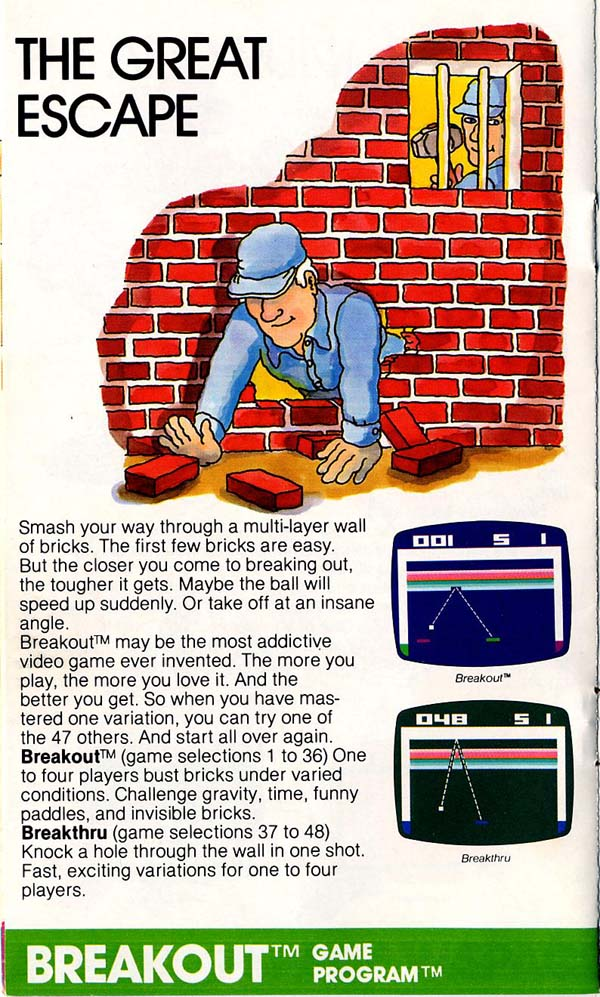
Maybe Atari’s marketing department isn’t exactly sure what the game was all-about.
The playfield is symmetrical with long horizontal lines of playfield graphics that form the brick wall to “breakout” from.
The “player” is a long, thin paddle at the bottom of the screen.
The “ball” is a ball of square pixels.
I begin playing and I am hooked almost instantly.
The elegant side-to-side movement of the paddle and the simple musical tones that emanate from the TV whenever the ball touches anything.
They put me into a near hypnotic state.
The sense is intensified when I hit the ball into the brown row of bricks.
This action increases the ball speed and shrinks my paddle.
The action goes from pleasant to manic in an instant..
Each time I hit the ball with the paddle, a sense of relief swells over me.
It is quickly dislodged by fear as the ball hits a brick or the wall, bounces back and races back towards the bottom of the screen.
Euphoria and horror trade places in less than a second.
Alternating.
A musical score of my own design is created by the bouncing ball.
It falls upon me.
I “break through” the top of the brick wall
The ball begins a brick-wall-brick-brick-wall dancing act at the top of the screen.
The game transcends to a different experience.
How long will the ball stay in that top cavity?
How much damage will it do to the wall while it is up there?
The reward of the game comes not from winning but from playing.
Staying alive so that beautiful, euphoric, hypnotic feeling will not end.
I miss the ball as it comes back down
It makes me angry.
One more ball, and one more game is all I care for that afternoon.
I am going to keep it going.
I am going to clear the screen of bricks.
I need to.
I have to.
The limitations of the Breakout world makes me feel like I can master it.
It was in direct contrast to the world of CCD.
The world of The Catholic Church.
The world of my sisters, my mom, and my dad
The the reality that people died
Where things will never be the same.
The real world?
That is a world I am passing through.
It masters me.’
People are alive in the real world, like my cousin Greg and Aunt Pat.
Then while you are blissfully sleeping away dreaming about AYSO soccer and your 3rd grade “Bees” report,
They are taken from you.
But the Atari VCS?
That was something I felt I could master.
The birthday party continues in the backyard.
I don’t remember any of it.
The only reason I know I went outside is because I have a few photos from that day with all the kids around Lori’s new backyard jungle gym,
I want to be inside.
With the game.
With Breakout.
—
Jeff and I continue to be good friends with Lori through our Catholic First Communion in May of 1979
And through the next summer.
However, by the fall things change.
Lori continues on to Third Grade CCD, while Jeff and I skip to Fourth Grade so we could be with kids our own age.
We hang out every once-in-a-while, but with no CCD excuse to get together, our visits become more and more infrequent until they evaporate completely.
Our friendship reveals itself to be a bit of a mirage.
Maybe just a convenient way for her to have companions and for us to play Atari?
It morphs from “best friends” to “waving in the halls” to “an occasional smile”
Liori leaves Pennekamp school and starts Catholic School the next year
After that she appears to drop off the face of the planet entirely.
—
In 4th grade I still think about playing the Atari VCS often.
My mind wanders around those good days with Lori, CCD First Communion, and then meanders to our cousins.
I think about how impossible it is to make the world into what I want.
Playing Breakout though, that was different.
The rules are simple.
Defined.
Finite.
I know I am in complete control of my little universe when I play.
And I also know this:
If I was good enough,
I can make the game last as long as I want.
Maybe…
…even…
…forever…
-Steve Fulton


Leave a Reply